How Long Do Garage Door Springs Last_ Life Cycle Chart

How Long Do Garage Door Springs Last? Life Cycle Chart

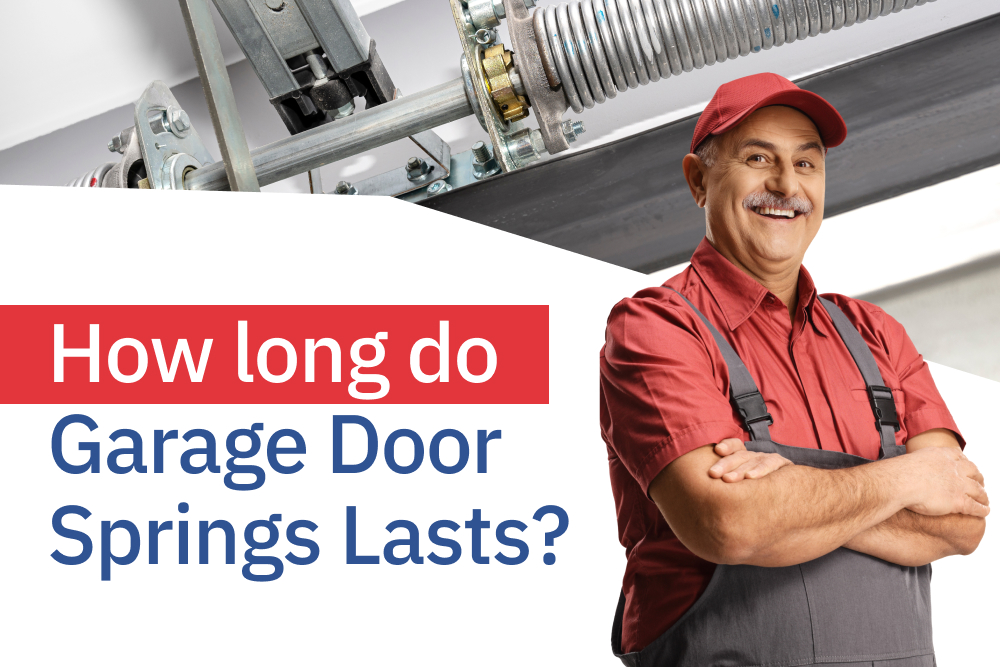
How long do garage door springs last? Garage door springs typically last 7 to 10 years in an average residential setting, with most standard torsion springs rated for about 10,000 cycles. A cycle is one full open and close of your garage door, so daily usage directly determines how quickly that rating is used up. If your household runs the door several times a day, the spring will naturally wear out sooner than in a low-use home.

The actual lifespan of a garage door spring depends on correct spring sizing, proper installation, and door weight. These physical stressors can shorten your garage door springs in as little as 3 to 5 years.

In this guide, we’ll break down how long garage door springs usually last, complete with lifespan charts. We’ll also explain what causes premature garage door spring failure and how a weakening spring can strain your garage door opener and raise long-term repair costs.

Quick answer: What is the average lifespan of garage door springs?

  • The average garage door spring lifespan is 7 to 10 years in most residential homes under normal daily use.
  • Torsion spring lifespan: 7 to 10+ years — considered the most durable residential option due to superior weight distribution.
  • Extension spring lifespan: 5 to 9 years — shorter than torsion systems because constant stretching causes higher metal fatigue.
  • In high-usage households, average garage door spring life drops to 3 to 5 years as cycling the door 6 to 8+ times daily exhausts its mechanical limit.

👉 Need help with your garage door springs? Our technicians are on-call –  click here for 24/7 garage door service!

What a 10,000-cycle garage door spring rating means

A 10,000-cycle rating defines how many complete lifting cycles a garage door spring can perform before metal fatigue reaches its expected limit. One cycle equals one full opening and one full closing of your garage door.

Once a spring approaches that cycle threshold, internal steel stress increases and breakage becomes statistically more likely.

How daily garage door usage affects spring lifespan

Daily garage door usage directly determines how quickly a 10,000-cycle spring reaches the end of its service life. If you run your garage door four cycles per day, that equals roughly 1,460 cycles per year. At that usage level, a standard spring reaches its rated lifespan in approximately 6 to 7 years.

Situations when garage door springs may fail earlier than expected

Garage door springs are engineered for predictable cycle ratings, but real-world conditions often reduce that expected lifespan. When load, balance, or installation standards are off, metal fatigue accelerates, and the spring can break years earlier than its rated capacity.

Common situations that shorten garage door spring lifespan include:

  • Undersized springs for the door weight – A spring that is too small works beyond its intended torque range, which rapidly increases internal stress.
  • Improper installation or incorrect tensioning – Overwound or underwound torsion springs create uneven load distribution, leading to premature fatigue.
  • Unbalanced garage door systems – If your garage door doesn’t stay halfway open during a manual balance test, the spring is carrying uneven force.
  • High daily usage – Homes using the garage as the primary entry point consume rated cycles much faster than low-use properties.
  • Corrosion and humidity exposure – Moisture causes surface rust, which weakens spring steel and reduces the realistic garage door spring lifespan.
  • Heavy insulated or solid wood doors – Added door weight increases torque demand, shortening the effective torsion spring lifespan.

When these factors are present, garage door spring failure can occur in as little as 3 to 5 years instead of the expected 7 to 10.

Garage door spring lifespan chart based on daily garage door usage

Most residential torsion systems are built around a standard spring cycle rating of 10,000 cycles. That rating comes from controlled industry cycle testing, where springs are repeatedly wound and unwound until metal fatigue causes failure.

In real-world service calls, our technicians see similar patterns, but daily household usage determines how quickly that rating is consumed.

Below is a practical spring lifespan chart based on a 10,000-cycle spring:

Garage Door Cycles per Day   Annual Cycles (Approx.)   Estimated Garage Door Spring Lifespan (Years)  
2 cycles per day   730 cycles   13–14 years  
4 cycles per day   1,460 cycles   6–7 years  
6 cycles per day   2,190 cycles   4–5 years  
8 cycles per day   2,920 cycles   3–4 years  
10 cycles per day   3,650 cycles   2–3 years  

Estimated spring lifespan if the garage door is used 2 cycles per day

At 2 garage door cycles per day, the system completes roughly 730 cycles per year. A standard 10,000-cycle spring can theoretically last 13 to 14 years at this rate. In practice, our technician data shows many low-use homes reaching or slightly exceeding that range when springs are properly sized, and corrosion is minimal.

Estimated spring lifespan if the garage door is used 4 cycles per day

At 4 cycles daily, annual usage increases to about 1,460 cycles. This level of use brings the expected garage door spring lifespan to roughly 6 to 7 years. This range aligns closely with the commonly cited national average for residential garage door usage lifespan.

Estimated spring lifespan if the garage door is used 6 cycles per day

At 6 cycles per day, the total annual cycles approach 2,190. Under this workload, a standard spring typically reaches failure around 4 to 5 years. Homes using the garage as a primary entrance often fall into this category.

Estimated spring lifespan if the garage door is used 8 to 10 cycles per day

At 8 to 10 daily cycles, annual usage ranges between 2,920 and 3,650 cycles. This usage level reduces expected lifespan to approximately 2 to 4 years. Frequent in-and-out activity significantly accelerates metal fatigue within the torsion spring.

Expected garage door spring lifespan for heavy-use households and multiple daily cycles

Heavy-use households, multi-driver homes, or properties with attached workshops may exceed 10 cycles per day. In these cases, even a properly installed 10,000-cycle spring may fail in as little as 2 to 3 years.

For high-frequency use, our technicians often recommend upgrading to 20,000-cycle or higher-rated springs to extend predictable service life.

Lifespan comparison: torsion springs vs extension springs

When comparing garage door spring types, durability is one of the biggest differences homeowners should understand. The debate around torsion springs vs extension springs is not just about placement on the door, but about cycle capacity, stress distribution, and real replacement frequency.

Below is a side-by-side torsion vs extension comparison chart:

Variable   Torsion Springs   Extension Springs  
Mounting location   Mounted above door on a torsion shaft   Mounted along horizontal tracks  
Energy storage method   Rotational torque around shaft   Linear stretch and contraction  
Typical base cycle rating   10,000 cycles (20,000+ high-cycle options available)   Often 5,000–10,000 cycles depending on build  
Average residential lifespan   ~7–12 years with moderate use   ~4–8 years with moderate use  
Stress distribution   Even load across the coil   Load focused at stretch points and hooks  
Hardware dependency   Fewer moving connection points   Uses pulleys, cables, safety cables, hooks  
Door compatibility   Better for heavy or insulated doors   Common in lighter, standard doors  
Wear pattern   Gradual weakening along the coil   Faster wear at extension and hook points  
Why they wear   Repeated winding and unwinding under load   Repeated stretching plus hardware friction  
Replacement frequency   Less frequent in comparable use   More frequent under similar usage  

Which garage door spring type lasts longer in real-world conditions

In most homes, torsion systems last longer than extension systems under the same daily usage. The reason comes down to how the load is handled and how evenly the spring supports the garage door weight.

Here’s how each garage door spring type works in real-world conditions:

Torsion springs last longer under these conditions:

  • Wide double-car garage doors that require a balanced lift across a long span
  • Doors with added weight from insulation upgrades or decorative overlays
  • Garages with minor structural settling where centered load distribution matters
  • High-frequency operation in multi-vehicle households
  • Situations where long-term durability is prioritized over initial cost

Extension springs last longer under these conditions:

  • Lightweight single-car garage doors with minimal added hardware
  • Installations with limited headroom where torsion hardware cannot fit
  • Budget-focused setups where shorter service intervals are acceptable
  • Detached garages with lower daily open-and-close usage
  • Applications where track alignment and hardware are consistently maintained

Replacement frequency differences homeowners should expect

Under moderate use, torsion springs may require replacement roughly once per decade. Extension springs under similar conditions are more likely to need replacement several years sooner.

If your garage door cycles are high, both systems wear faster, but torsion setups generally provide longer service intervals.

Standard vs high-cycle garage door springs: how long each cycle rating lasts

Standard residential systems often start at 10,000 cycles, while high-cycle garage door springs are commonly rated at 20,000, 25,000, or even 50,000 cycles, depending on supplier specifications. These ratings are based on controlled cycle testing and proper installation standards.

Below is a practical garage door spring lifespan comparison based on moderate use of 4 cycles per day (≈1,460 cycles per year).

Garage Door Spring Cycle Rating   Estimated Lifespan (4 Cycles/Day)   Typical Use Case  
10,000 cycles   6–7 years   Standard residential setup  
20,000 cycles   13–14 years   Moderate high-use households  
25,000-cycle springs   17 years   Multi-driver homes  
50,000-cycle heavy-duty garage door springs (commercial springs)   30+ years   Very high daily usage  

Lifespan of standard 10,000-cycle garage door springs

A 10,000-cycle garage door spring is the baseline rating installed in many residential properties, not to mention its lower upfront cost. They work well for moderate daily use but leave less margin for households where garage access is frequent.

Lifespan of 20,000-cycle garage door springs

A 20,000-cycle garage door spring provides double the rated lift cycles of a standard 10,000-cycle spring. This upgrade does not change how the door operates, but it increases the total number of reliable lift cycles before internal wear becomes critical. It’s a common middle-ground upgrade for homeowners who want fewer long-term replacements.

Lifespan of 25,000-cycle garage door springs

25,000-cycle springs are a common garage door spring upgrade for households with consistent daily usage. The higher rating provides additional service margin, which reduces the likelihood of early replacement caused by fluctuating usage patterns or heavier door configurations.

Lifespan of 50,000-cycle heavy-duty garage door springs

Heavy-duty garage door springs rated at 50,000 cycles are engineered with thicker wire diameter and larger coil geometry. These larger, often powder-coated coils are designed for high-traffic environments and extreme durability. While requiring the highest upfront investment, they can last over 30 years, often outliving the actual garage door panels.

Cost-per-year lifespan comparison between standard and high-cycle springs

A clearer way to evaluate a garage door spring upgrade is to compare total service life against the installed price. The table below shows the long-term ROI of a garage door spring upgrade based on typical residential usage:

Spring Cycle Rating   Estimated Lifespan (Years @ 4 Cycles/Day)   Typical Installed Cost*   Estimated Cost Per Year   Replacement Frequency (30-Year Period)  
10,000 cycles   6–7 years   $250–$350   $36–$50 per year   ~4–5 replacements  
20,000 cycles   13–14 years   $350–$450   $25–$34 per year   ~2–3 replacements  
25,000 cycles   ~17 years   $400–$500   $23–$30 per year   ~1–2 replacements  
50,000 cycles   30+ years   $600–$750   $20–$25 per year   ~1 replacement  

Key factors that determine how long garage door springs last

While the cycle rating provides a baseline, the actual average garage door spring life is dictated by a complex interplay of mechanical load, environmental conditions, and user behavior. Understanding these cause-and-effect factors allows you to better predict potential failure and adjust your maintenance schedule accordingly.

Here are the factors that could affect how long your garage door spring will last:

1. Garage door weight, balance, and load stress impact on spring lifespan

A residential garage door can weigh anywhere from 150 to over 500 pounds, and this garage door weight impact is the primary driver of metal fatigue. Springs act as a counterweight; if a door is heavy due to solid wood construction or thick insulation, the springs remain under higher tension even when static.

An imbalanced door—where the spring load stress is not perfectly matched to the door’s weight—forces the coils to over-torque or over-elongate. This mechanical misalignment can shave years off your door spring’s life, often leading to breakage in just 3 to 5 years.

2. Climate, humidity, rust, and corrosion effects on spring durability

Environmental exposure directly affects a garage door spring’s structural integrity. Moisture exposure leads to corrosion spring damage, which creates surface pitting along the steel coil. That surface damage becomes a structural weak point under repeated torque.

Temperature swings further expand and contract the metal, which compounds stress during each lift cycle. Over time, these conditions reduce your garage door spring’s cycle performance.

3. Installation quality, spring sizing accuracy, and tension calibration

Installation accuracy determines whether your garage door spring reaches its published cycle rating. Manufacturers specify wire diameter, coil length, and inside diameter for each door weight range.

If those garage door springs’ specifications are incorrect, load distribution becomes uneven. Improper spring tension calibration during installation increases internal strain, which shortens its service life even when the spring appears properly rated.

4. Frequency of use in multi-vehicle households and high-traffic garages

In modern homes, the garage often serves as the primary entrance. High-traffic households that cycle the door 6 to 10 times daily for school runs, errands, and work will hit the 10,000-cycle mechanical limit in roughly 2.5 to 4 years.

For these high-frequency scenarios, technicians recommend upgrading to heavy-duty, high-cycle springs (25,000+ cycles) to maintain a reasonable 7-to-10-year replacement interval.

5. Maintenance habits, lubrication schedules, and inspection intervals

Routine care extends the garage door maintenance lifespan by reducing unnecessary wear. Skipping regular lubrication schedules allows friction to build between coils, generating heat and wear during every cycle.

A professional technician inspection every 6 to 12 months is recommended to check the balance and apply a high-quality silicone-based lubricant. These simple habits keep the metal supple and can extend the life of a standard spring by an additional 20% to 30%.

Warning signs your garage door springs are reaching the end of their lifespan

How Long Do Garage Door Springs Last_ Life Cycle Chart

Garage door springs show measurable wear before full breakage. These spring wear indicators progress from performance changes to structural failure. If you recognize early garage door safety warning signs, you can schedule service before a sudden break damages the opener or creates a safety risk.

Here are signs you need to schedule a garage door spring service:

1. Slower garage door opening, uneven movement, or jerking motion

Early-stage warning signs:

  • Slower-than-normal opening speed
  • Noticeable garage door uneven movement
  • Jerking or hesitation during lift

A weakening garage door spring produces less counterbalance force. As that lift support drops, your opener works harder to move the door.

That added strain increases wear across the system. These performance changes are common early spring failure symptoms technicians look for during inspection.

2. Loud snapping, popping, or banging sounds from the spring system

Mid-stage warning signs:

  • Sharp popping noises from the torsion shaft area
  • Repeated snapping sounds during operation
  • A sudden loud bang inside the garage

Internal coil stress builds as the garage door spring approaches its rated cycle limit. That stress can cause micro-fractures in the steel. If you hear a sudden loud bang, it’s often one of the clearest broken garage door spring signs, caused by stored tension releasing instantly.

3. Garage door feels heavier than normal when lifting manually

Mid-to-late stage warning signs:

  • Door feels unusually heavy during manual lift
  • Door does not stay halfway open during balance test

A properly calibrated garage door spring offsets most of the door’s weight. When the spring loses torque strength, the lifting force drops. If your garage door feels heavier than usual, the spring is no longer carrying its full share of the load. Our technicians confirm this with a manual balance test.

4. Visible rust, gaps, stretched coils, or spring separation

Late-stage structural warning signs:

  • Rust buildup along the coil surface
  • Gaps between torsion spring coils
  • Stretched extension springs
  • Visible coil separation

Surface rust signals corrosion spring damage, which weakens the steel material. These physical changes are clear spring wear indicators. If you see separation or widening gaps in the coils, the garage door spring is approaching failure.

5. Garage door stops midway or struggles to stay open

Failure-stage warning signs:

When a garage door spring loses calibrated torque, it can no longer counterbalance the door’s weight. If your garage door stops midway or won’t stay open, spring replacement should be scheduled promptly to prevent opener damage and additional repair costs.

How Long Do Garage Door Springs Last_ Life Cycle Chart

How to extend the lifespan of garage door springs safely

Proactive garage door spring maintenance can extend the life of your hardware by up to 25%, delaying the need for costly professional replacements. This can mitigate the friction and environmental stress that could lead to premature spring breakage.

Here’s a garage door maintenance schedule you can follow to extend the lifespan of your springs:

Maintenance Action   Recommended Frequency   Estimated Spring Lifespan Impact*  
Lubricate springs with garage-door-rated spray   Every 3–6 months   +10–20% lifespan  
Perform manual balance test   Once per year   +1–2 years if corrected early  
Professional spring inspection & tension check   Annually   Prevents 15–25% early wear  
Inspect and treat surface rust   Every 6 months   +1–3 years in humid climates  
Reduce unnecessary daily cycles (e.g., 6 → 4 per day)   Ongoing   +30–40% lifespan increase  

1. Proper lubrication frequency and recommended garage door lubricants

Lubricating garage door springs is the most effective way to reduce internal friction. Use a high-quality lithium or silicone-based spray rather than standard WD-40, which acts as a degreaser and can accelerate wear.

Apply the lubricant along the entire length of the coils every 3 to 6 months to prevent the metal from grinding against itself during the torsion cycle.

2. Annual garage door balance checks and spring tension inspections

A balanced door ensures the spring tension is doing the heavy lifting, not the opener motor. To check the balance, disconnect the opener and lift the door manually; it should remain stationary at the halfway point. If it falls or shoots upward, the springs require professional calibration. Routine checks prevent the uneven load distribution that causes one spring to fail prematurely.

3. Preventing rust and corrosion damage to extend spring life

Corrosion prevention is important for garage door springs in high-humidity or coastal climates. Surface rust creates “stress risers”—microscopic cracks where a snap is likely to occur.

Wipe down the garage door springs with a light coat of oil during your annual cleaning. This prevents moisture from penetrating the steel and maintains the structural integrity of the coils.

4. Reducing unnecessary daily garage door cycles to increase longevity

The simplest way to achieve spring lifespan extension is to minimize daily usage. Using the garage as a primary entryway for every dog walk or mail run consumes cycles rapidly.

By using a side entry door for foot traffic, you preserve the mechanical “mileage” of your garage door springs for vehicle entry only.

When homeowners should replace garage door springs proactively

Garage door springs don’t need to wait for failure before replacement. A clear garage door spring replacement timeline based on cycle rating reduces spring break risk and prevents opener damage. Planning a proactive spring replacement allows you to control timing instead of dealing with sudden failure.

Recommended spring replacement timeline based on cycle rating

Spring Cycle Rating   Typical Daily Use (4 Cycles/Day)   Suggested Spring Replacement Interval  
10,000 cycles   Moderate use   Replace at 6–7 years  
20,000 cycles   Moderate to high use   Replace at 12–14 years  
25,000 cycles   Multi-vehicle use   Replace at 15–17 years  
50,000 cycles   High-frequency use   Replace at 25–30 years  

Why replacing both garage door springs at the same time matters

Most double-car garage doors use a pair of torsion springs. When one spring fails, the other has likely reached its fatigue limit and will follow shortly. Replacing both simultaneously saves on labor costs and ensures the door remains perfectly balanced, protecting the opener from uneven load stress.

Risks and safety hazards of waiting until a spring fully breaks

While many homeowners wait for a mechanical failure to call a technician, reactive repairs carry significant dangers. A broken garage door spring is not just a convenience issue. It’s a critical safety hazard that can cause catastrophic damage to your property or physical harm to your family.

Here are risks and safety hazards that show why you should never delay garage door spring repairs:

  • Sudden door collapse. If a spring fails during operation, the door can slam shut. Without the counterbalance, the full garage door weight impact crashes down, potentially crushing vehicles or anyone in the threshold.
  • Entrapment hazards. A snapped spring often renders the door immovable. This creates a severe risk during emergencies, as vehicles are trapped inside and a primary home exit may be blocked.
  • Opener motor burnout. Operating a door with a failing spring forces the opener to lift the entire dead weight. This strain can strip drive gears or burn out the motor, leading to additional motor replacement costs.
  • Projectile dangers. When springs reach their breaking point, the energy release is violent. Extension springs can become dangerous projectiles, while torsion springs snap with enough force to shatter surrounding hardware.
  • Secondary component damage. The shock of a spring break often causes track misalignment or snaps lifting cables. Proactive spring replacement avoids this “domino effect” of expensive hardware failure.

Need help with your garage door springs? Call us 24/7!

If you are dealing with a broken spring or notice your door struggling to lift, California Garage Door Repair is ready to help 24/7. With over 20 years of hands-on garage door expertise, our team repairs and replaces garage door springs for any door brand, make, or model.

We proudly serve homeowners across Los Angeles, Hermosa Beach, and Sherman Oaks with fast response times and professional service.

Contact us today for same-day garage door spring repair!

How Long Do Garage Door Springs Last_ Life Cycle Chart

Garage door spring lifespan FAQs: homeowners ask most often

Why do garage door springs break more often in winter?

Garage door springs break more often in winter because cold temperatures cause steel to contract and become less flexible. That reduced flexibility increases internal stress during each open-and-close cycle. If a garage door spring is already near its rated cycle limit, cold weather can push it past failure.

Winter does not create the wear, but it often exposes existing metal fatigue.

Should I replace both springs if only one breaks?

Yes, in most cases, both garage door springs should be replaced together. Torsion springs installed as a pair complete the same number of cycles. If one spring breaks, the second spring has already experienced identical wear.

Replacing only one spring creates an imbalance and increases strain on the older spring, which often leads to another failure shortly afterward.

What is the average cost of garage door spring replacement in 2026?

The average cost of garage door spring replacement in 2026 ranges from $250 to $450 for standard 10,000-cycle torsion springs in most residential garages. High-cycle garage door springs typically range from $400 to $750 installed, depending on cycle rating (20,000–50,000 cycles) and door size.

Final pricing depends on spring type, cycle rating, and labor. Licensed installation is recommended due to stored tension and safety risk.

To get a free spring replacement cost estimate, you can request a quote from CaliforniaGarageDoorRepair.

How often should garage door springs be inspected?

Garage door springs should be inspected at least once per year. An annual inspection checks balance, tension, rust buildup, and visible spring wear indicators. High-traffic garages may benefit from inspection every 6 months.

Regular inspection helps identify weakening springs before sudden breakage occurs and supports a longer overall garage door spring lifespan.

Is upgrading to high-cycle garage door springs worth the cost?

Upgrading to high-cycle garage door springs is highly cost-effective for households that use the garage as a primary entrance. While the upfront price for 25,000 or 50,000-cycle springs is higher, the cost-per-year is significantly lower than standard units.

Investing in high-cycle hardware reduces the frequency of labor fees and service calls, providing much better ROI and long-term reliability for active families.

Get Free Estimate
in Minutes

MM slash DD slash YYYY
Full Name(Required)
This field is hidden when viewing the form
Address(Required)

This site is protected by reCAPTCHA and the Google Privacy Policy and Terms of Service apply.